
What Is an ATS, and Why Your CV Gets Filtered Out
You send a strong CV to a job you are clearly qualified for, and hear nothing. It is easy to assume a person read it and passed. Often, no person ever did. A piece of software read it first, scored it against the posting, and ranked it below the cut. That software is an ATS, and understanding how it scores is the difference between guessing and fixing.
What an ATS Actually Does
An Applicant Tracking System (ATS) is software companies use to collect and organise applications. It does not "auto-reject" out of spite. It parses each CV into fields, job titles, employers, dates, skills, education, then lets a recruiter search and rank by how well each one matches the role.
The trap is the ranking. When a posting draws hundreds of applicants, recruiters read from the top of the ranked list. A qualified CV that ranks low is, in practice, filtered out, even though nothing rejected it on purpose.
How the Match Is Scored
A good system does not just look for exact words. It matches your skills against the job's requirements in four ways:
- Direct match: the exact term appears in both (the job says "Python", so do you).
- Equivalent skill: same function, different tool (React for Vue, AWS for Azure).
- Implied skill: one skill assumes another (vector databases imply embeddings).
- Category match: a specific tool satisfies a general need (FastAPI counts as an API framework).
Then it weights the result. Not every part of your CV counts the same. A typical breakdown looks like this:
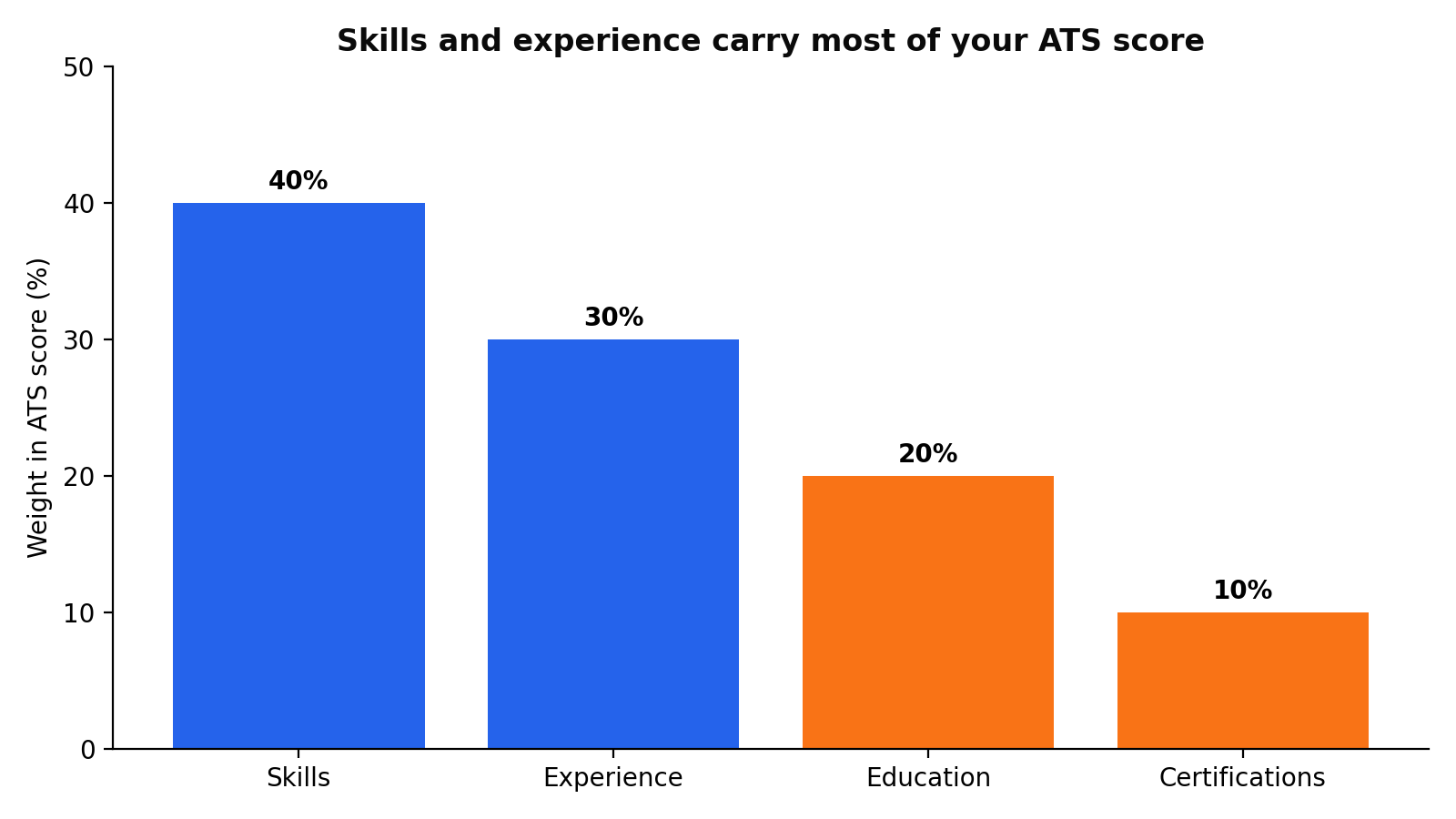
Skills coverage and relevant experience carry most of the score. That is why a CV heavy on education but thin on the job's actual skills ranks lower than you would expect, and why missing one or two required skills costs more than a missing certificate.
Why Qualified People Still Get Filtered
The usual reasons are boring and fixable:
| Reason | What happens |
|---|---|
| Skills only in a list | The system sees the word but not the proof, so the match is weak |
| Wrong wording | You wrote "ML"; the job wanted "machine learning", and the match missed it |
| Text inside an image | The parser cannot read it, so that skill effectively does not exist |
| Missing dates | Roles without dates parse badly and drag the whole CV down |
| One generic CV for all | It half-fits every job and fully fits none |
None of these mean you are unqualified. They mean the software could not see what you have.
How to Fix It
- Put each key skill in an experience bullet, not only in a skills section.
- Use the job's own wording for real skills you have. Match the term, not just the idea.
- Keep all text as real text. No skills hidden inside logos or graphics.
- Put dates on every role.
- Tailor per job: lead with the experience that matches this posting.
And never solve a low score by inventing skills. Tailoring means choosing and sharpening what is true, not adding what is not. A score won by lying collapses in the interview.
Check Your Score Before You Apply
You can see exactly how your CV scores against a specific job. myCVpath's ATS checker reads your CV the way an ATS does, compares it to the posting, and returns a score out of 100 with the breakdown above, plus the exact skills you matched and the ones you are missing. Fix the gaps first, then apply.